Data about you e.g. personal details and information about your health, will be stored in secure electronic databases. You will be given a unique study ID code, which will be used to identify your samples and questionnaires without using any personal details.
Any information from analysis (genetic and other tests) will be stored separately from your personal details using the unique study ID. Access to your personal details will be available to authorised members of the local study team (for example, your treating clinician and research nurses at site).
Data collected as part of the study will be stored in a secure electronic database called REDCap, using your unique study ID.
The staff responsible for managing the REDCap database at The Newcastle upon Tyne NHS Foundation Trust and Newcastle Clinical Trails Unit will also have access to some parts of your personal details. Paper copies of questionnaires (if used) will only include your unique study ID and never any personal details.
One of the health questionnaires used in this study asks you to record your current level of anxiety/depression. Should you record being severely or extremely anxious/depressed, staff within the Newcastle Clinical Trails Unit will notify the Principal Investigator at your hospital site, using your unique study ID. These investigators have access to the data collected, however this notification is to ensure this is brought to their attention swiftly

Samples will be mainly analysed by the IBD-RESPONSE team led from Newcastle University, but other centres around the UK including the WellcomeSanger Institute, University of Oxford, University of Cambridge, Imperial College London, Kings College London, University of Exeter, Queen Mary University of London and University of Edinburgh may analyse some study data.
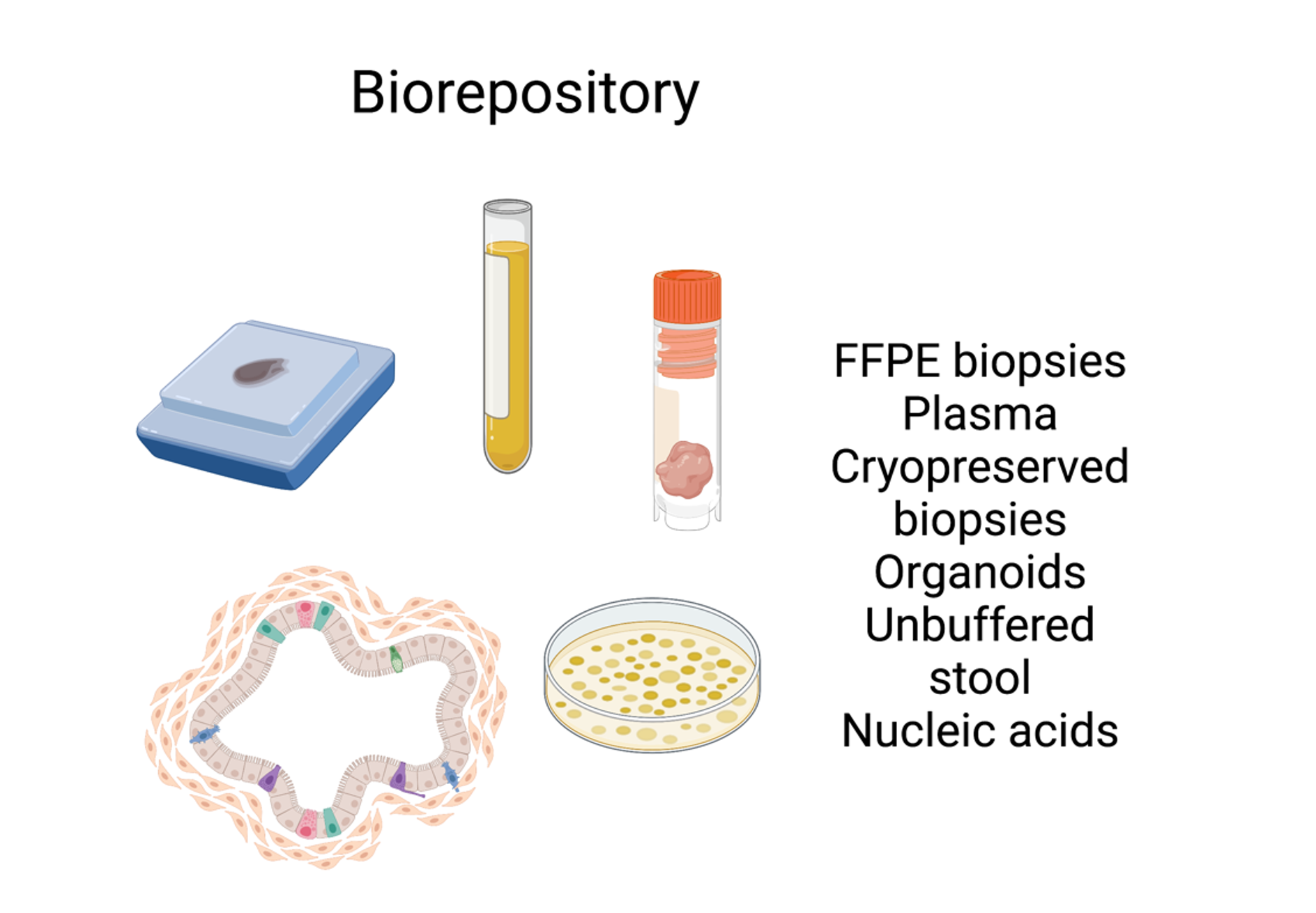
All samples will be stored in an ethically approved biobank for future research and will be overseen by a study management group (responsible for day-to-day management of the study) and a study oversight committee (which has overall responsibility for the study and includes independent clinicians, scientists and patient representatives).
With consent, your semi-anonymised data will be shared with the IBD BioResource and researchers who are part of the IBD-RESPONSE team across the UK, to allow for a more robust data analysis and comparison of outcomes.
These may include:
· Access to data only e.g. genetic information, questionnaires, age, sex, information associated with your postcode such as socio-economic status.
· Access to data and samples e.g. medication history, stored samples (including DNA and organoids) and questionnaires.The samples and data collected during the study may be requested by external researchers during or after the study. Before any of your anonymised data is given to external researchers, they will need to satisfy the following checks:
· Researchers requesting access to samples/data are required to submit their research questions and get approval for their study from an independent research ethics committee.
· The applications are then considered by the study management group (who has overall responsibility of approving the use of the samples) and, if needed, by the study oversight committee.
· Once approved, researchers will be given access to your anonymised data, which may mean that they get to keep your anonymised data.
However, they will need to keep the data safe as defined by law. Under no circumstances will information that identifies you personally, be disclosed.
Requests could come from researchers who are working in the public and charitable sector such as universities, research institutes, or from commercial companies such as pharmaceutical companies developing new treatments, either in the UK or overseas.
Your samples will not be used for animal testing or animal research. At the end of the study, anonymised study data, including sequencing data, will be uploaded to a public online archiving domain as is considered best practice by funding bodies and research journals. This will allow researchers to access anonymised data for any future research.